
Remote work or home office? These are the most important differences
Remote work and home office are often equated in everyday working life - but they do not mean the same thing.
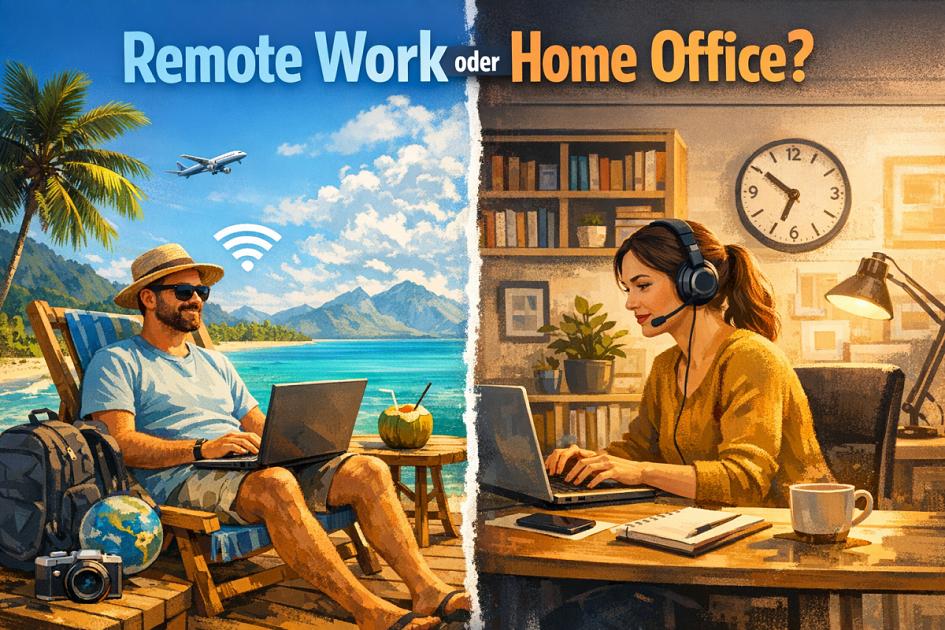
Remote work and home office are often equated in everyday working life - but they do not mean the same thing. Job seekers need to know the difference in order to categorise job offers correctly. Here you can find out how remote work and working from home differ and what this means for your career.
The 3 most important points at a glance
Home office is location-bound, remote work is location-independent
Remote jobs allow more flexibility, but mean more independent organisation
Not every home office position is a remote job
Definition: What does home office mean?
The term home office refers to a form of work in which employees carry out their work from home. The place of work is clearly defined: the employee's own home or a permanently furnished home office. In many cases, the company location remains the formal main place of work and the home office is only used on certain days or by arrangement.
Home office models usually include fixed working hours and availability requirements as well as a close connection to the office.
What is remote work?
Remote work means working from any location. Employees can complete their tasks from practically any location. This includes their own home, but also a co-working space or even abroad. It is not the place of work that matters, but the work result.
Remote work is usually organised on a project or results basis and involves a high degree of personal responsibility, self-management and digital communication.
The key difference: location-based vs. location-independent
The biggest difference between remote work and working from home lies in the flexibility of the work location. While home office is tied to a fixed private workplace, remote work guarantees the greatest possible freedom in the choice of work location.
For job seekers, this means that a job with a home office option may still require a regular presence in the office. A remote job, on the other hand, is usually completely location-independent.
Work organisation and expectations
The organisation of work also differs significantly between the two alternatives. Home office models often follow traditional office structures with clear working hours. Remote work, on the other hand, can often be organised more flexibly, with a stronger focus on results rather than attendance times.
Employers generally rely on strong communication skills, self-discipline and the confident use of digital tools for remote work.
What does this mean for job seekers?
It is essential for applicants to read job adverts carefully - and to understand them. Phrases such as "home office possible" or "remote work" should not automatically be equated. If you are looking for maximum flexibility, you should keep your eyes open for remote jobs and ask specifically about corresponding options during the application process.
At the same time, remote work does not suit every working style. Some people appreciate the clearly defined structures of a home office model with a regular office connection.
Conclusion: The difference is crucial
Remote work and home office represent different approaches to modern work. While the home office is a flexible addition to the office, remote work offers complete independence of location. With this distinction in mind, you can better evaluate job offers and choose the form of work that suits your own life situation.
More on the topic
What you need to watch out for with remote work
Dos and don'ts for working from home
How applicants get the right information about potential employers